Orlando turf prices are quoted in one number per square foot, and that number hides everything that decides whether the lawn lasts. This page breaks the band apart: what the grass costs, what the base costs, what removal adds, and what a real backyard lands at once the parts are added back together.
The installed band in Orange County
Published Orlando contractor pricing runs 8 to 16 per square foot for a complete professional installation, with 9 to 14 the band most Orange County jobs land in (https://orlandoartificialturfpros.com/artificial-turf-cost/). Angi puts the average Orlando job at $4,758 and its range at $2,811 to $6,950 (https://angi.com/articles/how-much-does-artificial-turf-cost/fl/orlando). A second local contractor publishes 8 to 12 per square foot for a standard lawn (https://siteproslandscaping.com/artificial-turf-installation/). Read the three together and the shape of the market is clear: a small yard in a modest subdivision sits near the bottom, a larger yard with base work and removal sits near the top, and the spread inside one city is wider than the spread between cities.
What the number does not tell you is the split. On a typical job the grass is a minority of the invoice. The base, the hauling and the labour are the rest, and those are the lines a homeowner can compare between quotes without knowing anything about turf.
Base, removal and the lines that move the total
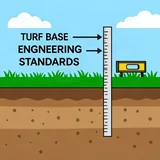
Removing an existing lawn and hauling the debris adds 1 to 3 per square foot. Excavation with a compacted crushed-rock base adds another 1 to 3 per square foot. Aggregate is sold by weight, at about $42 per ton for Class II road base and $52 per ton for washed open-graded drainage stone, and the geotextile separator under it runs about $0.48 per square foot.
Two of those lines are negotiable in the right way and one is not. Hauling is negotiable if the old sod can stay on site, which is rare on a small lot. Aggregate type is negotiable in the sense that a contractor may quote either grade, and the open-graded stone is the one that drains. Compaction is not negotiable at all: a base compacted in one lift instead of three will ripple inside two summers, and the cost of fixing it later is the whole job again.
Material alone
Grass by itself runs 2 to 6 per square foot for a basic residential product and 6 to 9 for premium pet-grade or high-face-weight turf. Face weight, backing and ultraviolet stabilisation are what the money buys. In Central Florida the ultraviolet load is the reason to care: on the EPA UV Index scale, 8 and above is very high to extreme, and Orlando sits in that band through most of the summer (https://www.epa.gov/sunsafety/uv-index-scale-0).
There is no salt air inland, so backing and infill last longer here than on the coast. That lowers the case for a premium product on a shady side yard and raises it on a west-facing lawn with full sun and a dog.
A worked 500 square foot backyard
Take 500 square feet, which is a normal Orlando backyard. A standard build at $10.00 per square foot installed lands at $5,000.00. A pet-proof build at $13.00 per square foot lands at $6,500.00. Both figures sit inside the published local band, and both include removal, base, grass, infill and edge work.
Scale it: a 300 square foot courtyard lands around $3,000, and a 1,000 square foot lawn lands between $8,000 and $10,000 depending on grade and access. Small jobs carry a higher rate per square foot because mobilisation is fixed, and a yard that a wheelbarrow cannot reach carries more again.
Frequently asked questions
What is the cheapest artificial grass that still lasts in Orlando?
A mid-grade product on a properly compacted open-graded base. Cheap turf saves 2 to 3 per square foot on material and costs the whole job again when it fades and flattens early. Spend the money on the base and take the mid-grade grass.
Why do three quotes for the same yard differ by thousands?
Almost always the base. One contractor removes 2 inches and compacts once, another removes 4 inches, builds in three lifts and adds a geotextile separator and a drainage outlet. Ask each one for the excavation depth, the aggregate type and the compaction method in writing.
Does the City of Orlando permit add to the cost?
Published permit allowances run 100 to 500. The city runs artificial turf as its own item in the residential permitting checklist, so ask who pulls it and whether the fee sits inside the quote.
Sources
- Orlando Artificial Turf Pros - artificial turf cost in Orlando
- Angi - synthetic grass installation cost in Orlando, FL
- Site Pros Landscaping - artificial turf installation price guide
- EPA UV Index scale
- City of Orlando - residential permitting requirements, artificial turf
Related
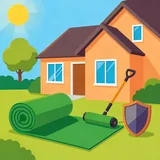
Artificial Grass services in Orlando
Orlando Artificial Grass Residential Grass
A residential artificial grass installation in Orlando is a drainage and sub-base project that happens to end with grass on top. The lawn is the last two days of the job; the base is everything else.

Orlando Artificial Grass Pet Grass
A pet yard is a plumbing problem with grass on top. Two dogs in a Orlando wet season produce far more urine than a thin base can carry away, and the smell people blame on the grass is ammonia from a base that holds water.
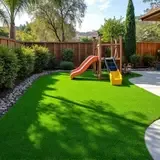
Orlando Artificial Grass Playground Grass
A playground surface is specified by what happens when a child falls on it. The grass is the top layer of a safety system, and the layer under it, the shock pad, is the part a cheap quote leaves out.
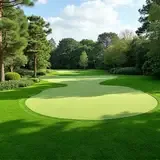
Orlando Artificial Grass Putting Greens
A putting green is the most precisely built surface in this trade. The ball tells the truth about the base, and a green laid over an uneven pad will not roll true no matter what the turf costs.
Orlando Artificial Grass Commercial Grass
Commercial work is judged on documents as much as on the surface. A property manager needs a specification, a drainage plan, a wind detail and a warranty schedule that survives an insurance review, not a square-foot price.
Areas we serve
Orlando
Artificial Grass in Orlando, FL - costs, water and soil notes.
Winter Park
Artificial Grass in Winter Park, FL - costs, water and soil notes.
Windermere
Artificial Grass in Windermere, FL - costs, water and soil notes.
Lake Nona
Artificial Grass in Lake Nona, FL - costs, water and soil notes.
Dr. Phillips
Artificial Grass in Dr. Phillips, FL - costs, water and soil notes.
Altamonte Springs
Artificial Grass in Altamonte Springs, FL - costs, water and soil notes.
Kissimmee
Artificial Grass in Kissimmee, FL - costs, water and soil notes.