Every Orlando installer says the same thing: the ground is sand, so water goes away. Then a July storm puts an inch down in an hour and a corner of the yard holds it for two days. Sand drains, but a lawn does not drain into sand unless the build was designed for it.
Why sand alone is not drainage
Orlando sits on the Orlando soil series, a deep, very well-drained sand mapped across Orange County (https://soilseries.sc.egov.usda.gov/OSD_Docs/O/ORLANDO.html). In its natural state it takes water fast. Three things change that on a built lawn.
- Compaction. A base is rolled flat by design. The same pressure that makes the surface stable closes the pore space under it.
- Fines. Sand and dust migrate down into the base over a few seasons and fill the gaps that did the draining.
- Grade. A flat lawn under a roofline that sheds onto it collects water faster than any base can pass it.
So the question is not whether Orlando has draining ground. It is whether the build gave the water a path with a slope and an outlet.
The build that drains
Four parts: a graded sub-base that falls away from the structure, a non-woven geotextile separator that stops fines migrating up into the stone, an open-graded crushed-rock base compacted in lifts, and a positive outlet at the low end, either a drainage structure or a swale that leads somewhere legal.
Perforated backing and a heavier infill help the surface pass water. They cannot fix a base with no fall. Washed open-graded stone runs about $52 per ton against $42 for Class II road base, and the geotextile is about $0.48 per square foot. That is the difference between a lawn that drains and one that ponds, and it is small money against a rebuild.
Reading a ponding lawn
Where the water sits tells you what failed. Water against the house means the grade is wrong or the base sank at the wall. Water in one corner means there is no outlet and the low spot is doing all the work. Water across the whole surface after heavy rain, clearing within hours, is usually a slow but working system, not a failure.
Water that stands for a day or more in the same place, every storm, is a base failure. It will not improve on its own, and the grass under it will flatten and stain first.
Fix or rebuild
A localised low spot can be lifted, re-graded and re-set for a few hundred dollars. A base that was never drained needs the turf lifted, the stone replaced or reworked and an outlet added; on a typical yard that is a substantial fraction of the original cost, which is why the outlet belongs in the first quote.
One cheaper measure sometimes works: cut a slot drain or a French drain at the low edge and lead it to a legal discharge point. It helps a yard that is nearly right. It does not rescue a base that sits on compacted construction fill.
What a correct outlet looks like
An outlet is the part of the build that carries water from under the lawn to somewhere it is allowed to go. On most Orlando lots that is one of four things: a pop-up emitter at the low corner that discharges onto the grade, a connection into the lot stormwater system where the plat allows it, a dry well sized for the stone around it, or a swale that runs to the street or to a retention area.
Ask the installer which one is proposed and where the water ends up. An answer that stops at "it drains into the sand" is not an outlet. Orlando sand takes water, but a compacted base over it does not, and on a lot that slopes toward the house the difference is a wet wall in August.
The outlet also has to be legal. Under Florida Statute 125.572 and DEP Rule 62-308.100, stormwater management is part of the state standard a turf installation has to meet, alongside permeability and proximity to trees (https://floridadep.gov/sites/default/files/SyntheticTurfFAQ%20final.pdf). Discharging onto a neighbour's lot is a drainage dispute waiting to happen, and Orange County and the surrounding cities each have their own rule on where roof and surface water may go.
Frequently asked questions
Why does water stand on artificial grass when the soil is sand?
Because the base was compacted and has no outlet. Water crosses the sand slowly once it is compacted and full of fines, and with no slope it has nowhere to travel.
Will a French drain fix it?
Sometimes. It helps where the yard is nearly right and only the low edge is the problem. It does not fix a base built over compacted fill with no fall.
How do I check drainage before I buy?
Hose the yard for twenty minutes before signing, then look ten minutes later. Where the water sits tells you the same thing it will tell you in July.
Sources
- USDA-NRCS official soil series description - Orlando series
- National Weather Service Melbourne - Central Florida
- St. Johns River Water Management District - watering restrictions
- Orlando Artificial Turf Pros - artificial turf cost in Orlando
Related
Artificial Grass services in Orlando
Orlando Artificial Grass Residential Grass
A residential artificial grass installation in Orlando is a drainage and sub-base project that happens to end with grass on top. The lawn is the last two days of the job; the base is everything else.

Orlando Artificial Grass Pet Grass
A pet yard is a plumbing problem with grass on top. Two dogs in a Orlando wet season produce far more urine than a thin base can carry away, and the smell people blame on the grass is ammonia from a base that holds water.
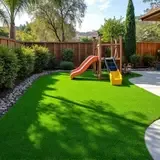
Orlando Artificial Grass Playground Grass
A playground surface is specified by what happens when a child falls on it. The grass is the top layer of a safety system, and the layer under it, the shock pad, is the part a cheap quote leaves out.
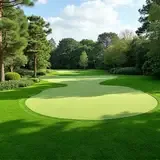
Orlando Artificial Grass Putting Greens
A putting green is the most precisely built surface in this trade. The ball tells the truth about the base, and a green laid over an uneven pad will not roll true no matter what the turf costs.
Orlando Artificial Grass Commercial Grass
Commercial work is judged on documents as much as on the surface. A property manager needs a specification, a drainage plan, a wind detail and a warranty schedule that survives an insurance review, not a square-foot price.
Areas we serve
Orlando
Artificial Grass in Orlando, FL - costs, water and soil notes.
Winter Park
Artificial Grass in Winter Park, FL - costs, water and soil notes.
Windermere
Artificial Grass in Windermere, FL - costs, water and soil notes.
Lake Nona
Artificial Grass in Lake Nona, FL - costs, water and soil notes.
Dr. Phillips
Artificial Grass in Dr. Phillips, FL - costs, water and soil notes.
Altamonte Springs
Artificial Grass in Altamonte Springs, FL - costs, water and soil notes.
Kissimmee
Artificial Grass in Kissimmee, FL - costs, water and soil notes.