Florida changed the rules for artificial turf in 2025, and the change runs in both directions: it gives homeowners a state standard a city cannot override, and it gives everyone a specification the lawn has to meet. Here is what the law says, what the rule adds, and what it does not touch.
What the statute says
Section 125.572 of the Florida Statutes, created by chapter 2025-140, defines synthetic turf as a manufactured product that resembles natural grass and is used as a surface for landscaping and recreational areas. It directs the Department of Environmental Protection to adopt minimum standards for installation on single-family residential properties of one acre or less (https://www.flsenate.gov/laws/statutes/2025/125.572).
The operative sentence comes next: once those standards are adopted, a local government may not adopt or enforce any ordinance, resolution, order, rule or policy that prohibits a property owner from installing synthetic turf that complies with the DEP standards, or that regulates it inconsistently with them. That is the part that changed the market. A city can still permit and inspect. It cannot simply ban the product.
What the DEP rule adds
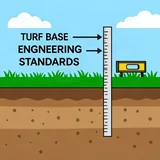
Rule 62-308.100 is the standard itself. It covers material type, colour, permeability, stormwater management, potable water conservation, water quality, and proximity to trees and other vegetation (https://floridadep.gov/sites/default/files/SyntheticTurfFAQ%20final.pdf). Two points matter to a homeowner reading a quote.
First, permeability and stormwater are in the rule, so a lawn that seals the ground under it is not automatically compliant. Second, DEP issues no permit of its own. The rule sets what local governments must allow and how they may regulate; the permit you actually file is a city or county one.
What it means in Orlando
The City of Orlando still runs artificial turf as its own item in the residential permitting checklist, with a required permit step, an eligibility check, a Notice of Commencement or Owner/Builder Declaration and a required plans list, and it links the rule to City Code section 60.224 (https://www.orlando.gov/Building-Development/Permits-Inspections/Get-a-Permit/Permitting-Checklists/Residential-Permitting-Requirements). Nothing in the 2025 statute deletes that step. It limits what the city may refuse.
Outside the city limits, Orange County and the surrounding cities run their own review, and most treat turf as impervious surface for stormwater purposes. Ask each jurisdiction how it classifies the lawn at that address before you sign a contract.
What an HOA can still do
A different statute governs associations. Section 720.3045 provides that, regardless of any covenant, restriction, bylaw, rule or requirement of an association, the association may not restrict an owner or tenant from installing, displaying or storing items on a parcel which are not visible from the parcel's frontage or an adjacent parcel, an adjacent common area, or a community golf course, and it names artificial turf in the list (https://www.flsenate.gov/laws/statutes/2025/720.3045).
Read precisely. A backyard the street cannot see is protected. A front yard is not. The association can still set appearance rules for what the street sees, and it can still require the surface to be maintained. Send the architectural package anyway, and keep the approval in writing, because a board that was never asked is a board that argues later.
What the law does not settle
Three things stay outside the statute. It does not set a maintenance standard, so an association can still require the surface to be kept clean and free of weeds. It does not override a recorded utility easement, because an easement is a property right and not a land-use rule. And it does not decide a dispute between neighbours about runoff, which is handled under nuisance and drainage law rather than turf law.
It also does not make a bad installation compliant. The rule speaks to material, permeability, stormwater, water quality and proximity to trees, so a lawn that seals the ground or was built over a root zone is not protected by pointing at the statute.
The practical reading for an Orlando homeowner: the paperwork is now shorter and the specification matters more. File the city or county permit, ask the association in writing, and spend the argument on base depth and drainage instead of on whether turf is allowed.
Frequently asked questions
Does the new law mean I do not need a permit in Orlando?
No. The state standard limits what a city may prohibit; it does not remove the city permit. The City of Orlando still requires a permit for artificial turf under its residential permitting checklist and City Code 60.224.
Can my HOA fine me for artificial turf in the front yard?
Section 720.3045 protects a parcel that is not visible from the frontage or an adjacent parcel. A front lawn is visible, so the association keeps its appearance rules. Get approval first rather than testing it.
Does the law cover condominiums and commercial property?
No. Rule 62-308.100 applies to single-family residential properties of one acre or less. Condominiums, duplexes, parks, athletic fields and commercial sites are outside it and are regulated locally.
Sources
- Florida Statute 125.572 - regulation of synthetic turf (2025)
- Florida DEP - Minimum Standards for the Installation of Synthetic Turf, Rule 62-308.100
- Florida Statute 720.3045 - installation, display and storage of items
- City of Orlando - residential permitting requirements, artificial turf
Related
Artificial Grass services in Orlando
Orlando Artificial Grass Residential Grass
A residential artificial grass installation in Orlando is a drainage and sub-base project that happens to end with grass on top. The lawn is the last two days of the job; the base is everything else.

Orlando Artificial Grass Pet Grass
A pet yard is a plumbing problem with grass on top. Two dogs in a Orlando wet season produce far more urine than a thin base can carry away, and the smell people blame on the grass is ammonia from a base that holds water.
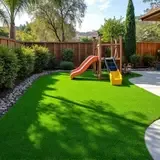
Orlando Artificial Grass Playground Grass
A playground surface is specified by what happens when a child falls on it. The grass is the top layer of a safety system, and the layer under it, the shock pad, is the part a cheap quote leaves out.
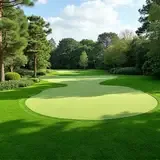
Orlando Artificial Grass Putting Greens
A putting green is the most precisely built surface in this trade. The ball tells the truth about the base, and a green laid over an uneven pad will not roll true no matter what the turf costs.
Orlando Artificial Grass Commercial Grass
Commercial work is judged on documents as much as on the surface. A property manager needs a specification, a drainage plan, a wind detail and a warranty schedule that survives an insurance review, not a square-foot price.
Areas we serve
Orlando
Artificial Grass in Orlando, FL - costs, water and soil notes.
Winter Park
Artificial Grass in Winter Park, FL - costs, water and soil notes.
Windermere
Artificial Grass in Windermere, FL - costs, water and soil notes.
Lake Nona
Artificial Grass in Lake Nona, FL - costs, water and soil notes.
Dr. Phillips
Artificial Grass in Dr. Phillips, FL - costs, water and soil notes.
Altamonte Springs
Artificial Grass in Altamonte Springs, FL - costs, water and soil notes.
Kissimmee
Artificial Grass in Kissimmee, FL - costs, water and soil notes.