Ponding is the most common Orlando artificial grass failure and the easiest to avoid. The wet season delivers short, heavy rain from June through September, and a base that cannot pass that volume turns the yard into a liner.
What ponding on artificial grass looks like
- Water still standing hours after the rain stops.
- Soft, spongy spots underfoot.
- Water held against the house, the patio slab or the block wall.
- Mosquito breeding in the low corner, which in Orlando is a public health matter rather than a nuisance.
Why artificial grass ponds in Orlando
Two causes dominate. The first is the aggregate: dense road base and stone dust compact into a nearly impermeable crust, so water stops at the surface. The second is the grade: a base laid flat, or falling toward the structure, has no outlet. In Orlando the ground beneath makes both worse, because the sand only drains fast where it has not been compacted, and the USDA-NRCS Orlando series mapped across Orange County is a deep, well-drained sand (https://soilseries.sc.egov.usda.gov/OSD_Docs/O/ORLANDO.html, HTTP 200) that still routes water sideways once a compacted base sits on top of it.
What a correct base does
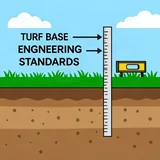
An open-graded, washed, angular aggregate keeps roughly 40 percent of its volume as void space, a continuous network of channels that passes water vertically. It sits over a non-woven geotextile on the compacted subgrade, under a thin bedding layer of clean chip stone, and it is graded with a fall away from the house to a legal outlet: a swale, a channel drain, or a tie-in to the lot drainage. Depth matters: 3 to 4 inches compacted for a lawn, deeper where dogs use the yard or where the subgrade holds water.
Repair options and cost
Re-grading plus a drainage aggregate, adding a channel drain, or installing a French drain to an outlet are the three practical routes, and all of them involve lifting and re-laying part of the surface. Minor works sit at a few hundred dollars; a section rebuild runs to several thousand. Compare that against a rebuild: washed open-graded drainage stone is published at $52 per ton against $42 per ton for dense road base, and the $10 difference per ton is what a base that drains costs over a base that holds.
What to ask an installer
- Which aggregate, and is it open-graded and washed?
- What is the compacted depth?
- Where does the water leave the yard?
- What is the fall away from the house?
Frequently asked questions
Is ponding covered by the warranty?
Rarely. Turf warranties cover the material, not the base, and almost every ponding case is a base failure. The workmanship warranty from the installer is the one that matters, and it is usually 1 to 5 years.
Can it be fixed without replacing the grass?
Sometimes. If the surface is sound and the base can be re-graded underneath, the grass can be lifted, the base corrected and the same grass re-laid. Where the aggregate itself is wrong, the base has to come out.
Does sand or stone dust help levelling?
No. Sand and stone dust compact into an impermeable layer that blocks the drainage and locks waste in place. Clean chip stone is the only bedding material.